
Table of Contents
1. Introduction
2. Main Product Range of Custom Auto Sensor Accessories & Connectors
3. Core Technical Requirements for Automotive-grade Sensor Components
4. Standardized Production Process of Custom Auto Sensor Parts
5. Performance Comparison: Custom Automotive Sensor Parts VS General Electronic Connectors
6. Common Defects of Auto Sensor Connectors & Optimized Solutions
7. Strict Quality Control System for Automotive Electronic Components
8. Typical Application Scenarios
9. Custom Development & Mass Production Cooperation Process
10. Conclusion
11. Industry FAQ
1. Introduction
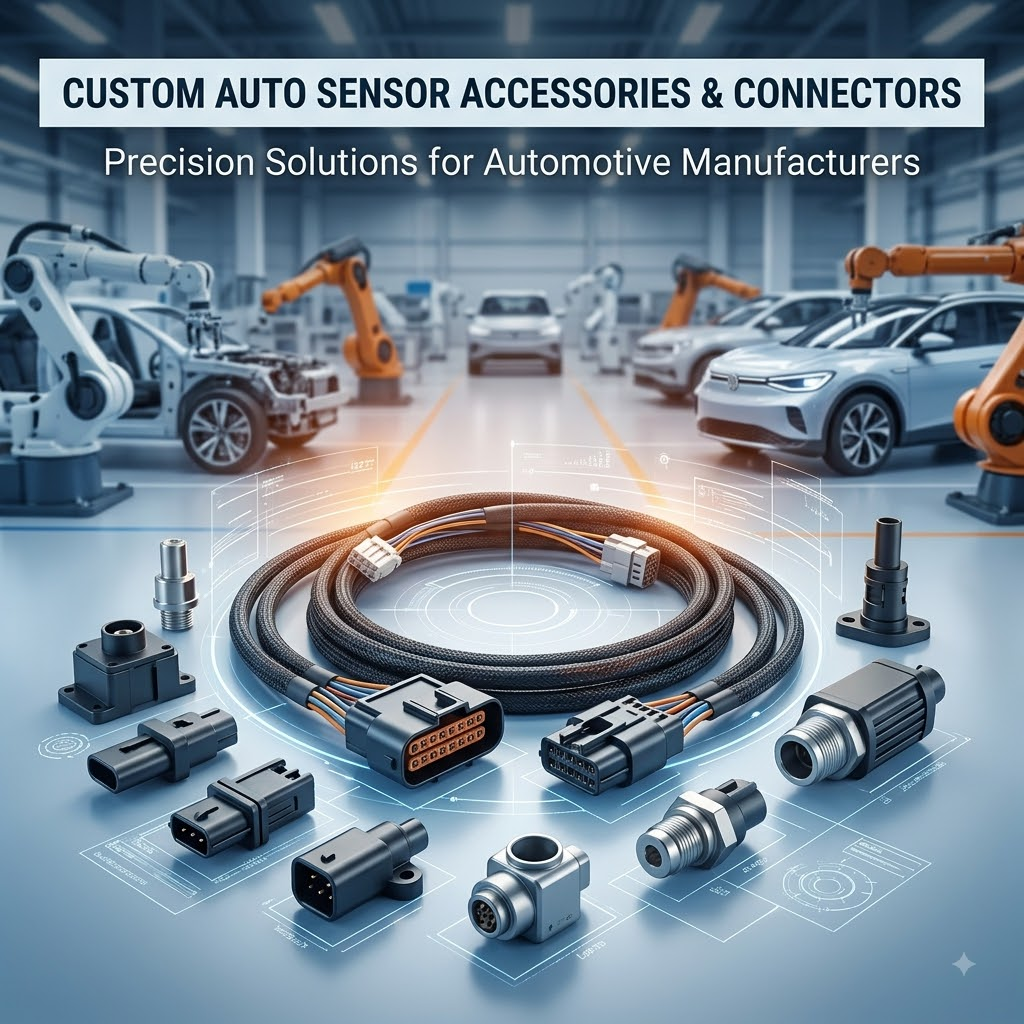
Automotive sensors are the perception core of vehicle electronic control systems, widely used in new energy vehicles, passenger cars and commercial vehicles. Sensor accessories and connectors undertake signal transmission, sealing protection and fixed assembly functions. Generic electronic connectors cannot meet the complex working conditions inside vehicles, including high temperature, vibration, humidity and chemical corrosion. Custom auto sensor accessories and connectors are tailor-made for automotive component manufacturers. Designed according to sensor structure, installation space and vehicle-level standards, these components ensure stable signal transmission, improve assembly efficiency and enhance the long-term reliability of finished automotive sensors.
Core Industry Keywords: custom auto sensor accessories, automotive sensor connectors, vehicle-grade electronic connectors, auto sensor assembly parts, custom automotive connectors, automotive electronic components, sensor wiring terminals, automobile sensor fitting parts
2. Main Product Range of Custom Auto Sensor Accessories & Connectors
2.1 Automotive Sensor Connectors
Plastic housing connectors, sealed waterproof connectors, terminal assemblies for temperature sensors, pressure sensors, speed sensors and position sensors.
2.2 Sensor Sealing Accessories
Magnetic sealing rings, rubber gaskets, O-rings and wear-resistant sealing components for sensor housing assembly.
2.3 Sensor Structural Accessories
ABS end covers, positioning brackets, fixed sleeves, protective shells and mounting bases for various sensors.
2.4 Conductive & Connection Parts
Copper terminals, contact pins, crimping components and wiring transition fittings matched with sensor assemblies.
2.5 Auxiliary Assembly Components
Anti-loosening fasteners, insulation sleeves and shock-absorbing buffer parts for sensor installation.
3. Core Technical Requirements for Automotive-grade Sensor Components
3.1 Vehicle-level Environmental Adaptability
Stable performance under wide temperature range: -40℃ ~ 125℃, resisting engine cabin high temperature and cold outdoor environment.
3.2 Reliable Waterproof & Dustproof Performance
Reach IP67 / IP6K9K protection grades to prevent water, dust and mud intrusion.
3.3 Anti-vibration & Anti-fatigue Capacity
Maintain stable contact performance under long-term road vibration without signal interruption.
3.4 Excellent Chemical Resistance
Resist erosion of engine oil, brake fluid, cleaning agents and automotive chemical media.
3.5 Consistent Dimensional Tolerance
Guarantee interchangeability for automated assembly lines of auto component factories.
4. Standardized Production Process of Custom Auto Sensor Parts
4.1 Technical Scheme Confirmation
Analyze customer drawings, sensor working conditions and vehicle certification requirements.
4.2 Mold Development & Prototyping
Develop injection molds and stamping molds; produce prototype samples for performance verification.
4.3 Raw Material Selection & Inspection
Adopt automotive-grade plastic, high-performance rubber and oxygen-free copper conductive materials.
4.4 Forming & Machining
Plastic injection molding, metal stamping, precision machining and terminal crimping.
4.5 Assembly & Sealing Treatment
Complete component assembly, glue injection and waterproof sealing process.
4.6 Multi-dimensional Performance Testing
Temperature cycling test, vibration test, waterproof test, conductivity and aging test.
5. Performance Comparison: Custom Automotive Sensor Parts VS General Electronic Connectors
表格
Evaluation Index | Custom Auto Sensor Accessories & Connectors | Ordinary General Electronic Connectors |
Material grade | Automotive-grade raw materials | Civil electronic common materials |
Operating temperature range | -40℃ ~ 125℃ | -10℃ ~ 70℃ |
Vibration resistance standard | Meet ISO 16750 automotive electronic standard | Only satisfy indoor static equipment |
Waterproof performance | IP67 and above optional | Mostly IP54 or lower |
Chemical medium resistance | Resist automobile oil and liquid corrosion | Easily swell and fail after contacting oil |
Long-term signal stability | Low contact resistance, no intermittent signal | Contact resistance drifts easily under temperature change |
Adaptability for auto automated assembly | Custom structure matching sensor assembly | Single specification, poor adaptability |
Data Reference: Society of Automotive Engineers (SAE) Industry Electronic Component Research Report Source URL: https://www.sae.org
6. Common Defects of Auto Sensor Connectors & Optimized Solutions
· Signal intermittent failure caused by poor contact: Optimize terminal structural design and control crimping precision.
· Water ingress leading to circuit short circuit: Improve sealing structure and adopt integrated injection sealing.
· Plastic shell deformation under high temperature: Replace with automotive high-temperature resistant plastic raw materials.
· Loosening after long-term vibration: Add anti-release locking structure on connector housing.
· Rubber sealing aging rapidly: Select EPDM or FKM automotive sealing rubber materials.
7. Strict Quality Control System for Automotive Electronic Components
7.1 Incoming Raw Material Inspection
Verify material certificates of automotive-grade plastics, metal terminals and sealing rubber.
7.2 In-process Patrol Inspection
Monitor injection molding size, terminal forming accuracy and assembly clearance.
7.3 Laboratory Performance Testing
Temperature cycle, vibration, waterproof and salt spray aging test for prototypes and batch products.
7.4 Finished Product Full Inspection
Conduct appearance detection and electrical conductivity screening before delivery.
7.5 Batch Traceability System
Record mold information, production date and test data for each batch of products.
8. Typical Application Scenarios
· Automobile speed sensors, pressure sensors, temperature sensors
· New energy vehicle battery sensors and motor position sensors
· Brake system and suspension monitoring sensors
· Engine intake and exhaust monitoring sensor assemblies
· Vehicle body electronic sensing modules
· Commercial vehicle engineering machinery sensor equipment
9. Custom Development & Mass Production Cooperation Process
1. Automotive component manufacturers provide sensor drawings, working conditions and performance standards
2. Technical team evaluate structure, select vehicle-grade materials and formulate development plan
3. Confirm quotation, develop molds and produce prototype samples
4. Support customer laboratory testing and vehicle road test verification
5. Start mass production after sample performance approval
6. Implement multi-stage quality inspection before shipment
7. Provide test reports supporting automotive product certification
10. Conclusion
Automotive sensors are critical safety-related electronic parts for vehicles. The reliability of supporting accessories and connectors directly affects the signal acquisition accuracy and service life of the whole sensor. Custom auto sensor accessories and connectors are developed targeting vehicle complex environments. They solve the adaptability problems of general electronic parts in automobile assembly. Automotive component manufacturers can obtain matched customized components, optimize sensor product stability, and meet strict vehicle-level certification requirements.
11. Industry FAQ
Q1: Can you develop sensor accessories and connectors according to customer drawings? A: We support OEM & ODM customized development based on customer sensor design drawings.
Q2: Are the raw materials automotive-grade and able to pass vehicle certification? A: We adopt automotive-grade raw materials, and can provide relevant material certificates for product certification.
Q3: What protection grades can customized connectors achieve? A: Our products can realize IP67, IP6K9K waterproof and dustproof structure according to requirements.
Q4: Can samples be supplied for customer performance testing? A: Prototypes can be produced for laboratory testing and vehicle trial assembly before mass production.
Q5: Are the products suitable for new energy vehicle sensor assembly? A: We have mature customized solutions for NEV battery sensors and motor sensors.