
Table of Contents
Introduction – The Critical Role of Sensors in Modern Vehicle Systems
Wheel Speed Sensors – The Foundation of ABS & Vehicle Stability
Magnetic Seals – Zero-Leakage Protection for Harsh Environments
ABS End Covers – Protection & Integration for Sensor Systems
Automotive Connectors – Reliable Signal & Power Interconnects
Quality Assurance & Manufacturing Standards
Frequently Asked Questions (FAQs)
1. Introduction – The Critical Role of Sensors in Modern Vehicle Systems
The automotive industry is undergoing rapid transformation toward electrification, automation, and connectivity. Regulations worldwide continue to raise requirements for active safety equipment, driving rapid adoption of ADAS sensors and related electronic systems . A single modern vehicle may contain 40 or more electronic control units, while high-end luxury models can have over 150—all requiring reliable sensors, connectors, and protective components to function properly .
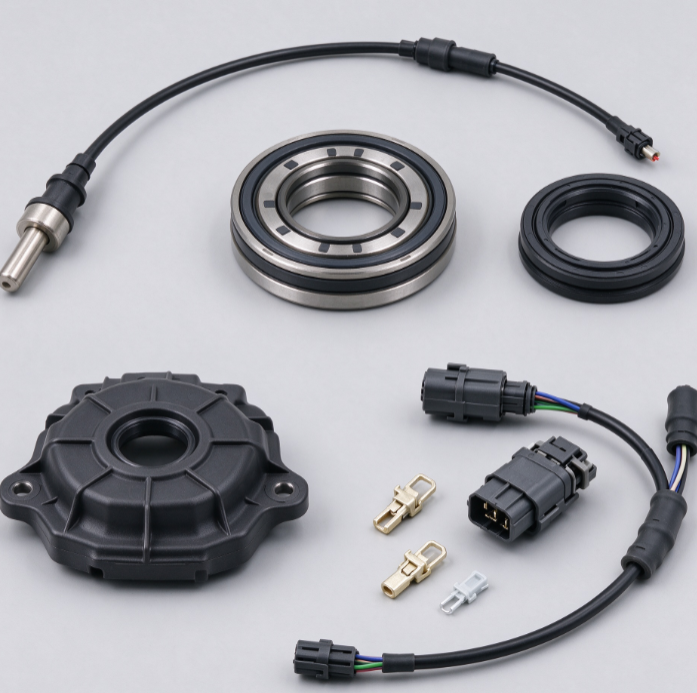
As a professional manufacturer of automotive sensors, we specialize in wheel speed sensors, magnetic seals, ABS end covers and automotive connectors. These components work together as an integrated system: wheel speed sensors provide critical data to the ABS control unit, magnetic seals protect sensor assemblies from contaminants and moisture, end covers secure and shield the sensor housing, and connectors ensure reliable signal transmission between components. Our products serve passenger vehicles, commercial vehicles, and motorcycle applications, backed by experience in mass production supply across diverse vehicle models .
2. Wheel Speed Sensors – The Foundation of ABS & Vehicle Stability
Wheel speed sensors, often referred to as ABS sensors, are critical components mounted on the wheel hubs near the brake rotors. They determine the rotational speed of each wheel and provide this data to the vehicle's ABS control module .
How They Work:
Wheel speed sensors operate on the magnetic induction principle. A toothed speed indicator ring (sensor rotor) rotates past the stationary sensor, generating a signal proportional to wheel speed. This signal is sent to the ECU through a twisted-pair wire cable and wiring harness . When the sensor detects that a wheel is about to lock up during braking, it signals the ABS module to release a small amount of brake pressure, allowing the wheel to maintain friction against the road surface .
Construction:
Most wheel speed sensors consist of a mix of plastic housings, aluminum or steel components, and electrical parts designed to interface with the vehicle's computer system. The sensor rotor is typically an internal gear-like structure integrally fixed to the wheel or brake drum .
Key Design Considerations:
·
Sensor placement: In many designs, the electromagnetic wheel speed sensor is internally fitted to and supported by the drum brake structure, positioned away from service holes to allow maintenance access
·
·
Durability: Sensors must resist moisture, oxidation, heat, and vibration encountered during normal driving conditions
·
·
Compatibility: Many wheel speed sensors are designed to be interchangeable across different makes and models
·
3. Magnetic Seals – Zero-Leakage Protection for Harsh Environments
Magnetic fluid seals (MFS) provide frictionless, leak-free sealing solutions essential for protecting sensor assemblies and other sensitive automotive components from contamination. Magnetic fluids are intelligent materials that possess both liquid fluidity and magnetic responsiveness, forming an adaptive sealing liquid ring under an external magnetic field .
Key Advantages:
·
Zero leakage: Magnetic seals maintain long-term stable, zero-leakage sealing performance, which is critical for keeping sensors free from moisture and debris
·
·
Self-healing capability: Even if the sealing liquid ring ruptures due to overpressure, it can spontaneously flow back under magnetic force and re-form the sealing interface—extending component life under intermittent overload conditions
·
·
Frictionless operation: Unlike mechanical seals, magnetic seals operate without mechanical friction, preventing wear and extending service intervals
·
Performance Characteristics:
Recent experimental studies have shown that magnetic fluid seal pressure resistance is governed by both radial and axial sealing gaps. The self-healing performance of the seal assembly is influenced by key parameters including the number of pole teeth, sealing gap dimensions, and tooth geometry. Optimized designs can recover pressure resistance exceeding 1 atmosphere after sealing failure . For automotive sensor applications, these seals provide the environmental protection needed to ensure long-term reliability in brake and wheel hub assemblies.
4. ABS End Covers – Protection & Integration for Sensor Systems
ABS end covers serve as protective housings that secure and shield wheel speed sensor assemblies and associated electronic components. These covers are typically manufactured from durable plastic materials (such as ABS resin) that provide impact resistance, dimensional stability, and environmental protection .
Functions of ABS End Covers:
·
Mechanical protection: Shielding sensitive sensor components from physical damage, dust, and moisture ingress
·
·
Integration: Providing mounting structures and alignment features for sensor positioning
·
·
Durability: Withstanding vibration, temperature cycling, and exposure to automotive fluids
·
End covers are designed to meet specific IP (Ingress Protection) ratings—typically IP20 for basic protection and higher ratings such as IP54 for more demanding environments . They are often available in standardized sizes and colors to match OEM requirements and can include features such as PCB mounting bosses and internal guide slots for component integration .
5. Automotive Connectors – Reliable Signal & Power Interconnects
Automotive connectors are critical interfaces that ensure reliable power and signal transmission between sensors, ECUs, and other vehicle systems. As vehicle architectures evolve from distributed ECUs toward centralized computing, connector requirements have become more demanding .
Connector Types Used in Sensor Systems:
·
Wire-to-board connectors: For connecting sensor wiring to PCB-mounted components
·
·
Wire-to-wire connectors: For modular harness joins and vibration-resistant connections
·
·
Board-to-board connectors: Used in compact electronic assemblies where multiple PCBs must interconnect
·
Key Requirements:
·
Compact size: Miniaturized connector systems with 1.8mm pitch can reduce PCB footprint by up to 50%, critical for space-constrained sensor modules
·
·
Automotive-grade robustness: Connectors must withstand high vibration, temperature extremes, and shock while maintaining contact integrity. Standards such as LV214 and USCAR govern automotive connector systems
·
·
Current and signal capability: Signal terminals typically support up to 6A, with wire sizes ranging from 0.13–0.35mm² for signal applications
·
For wheel speed sensors, connectors must provide secure, vibration-resistant connections that maintain signal integrity under all driving conditions. In many designs, sensor signals are transmitted through twisted-pair wire cables and wiring harnesses to the ECU . Connector systems are available with primary and secondary locking capabilities, anti-stubbing features, and CPA (Connector Position Assurance) options .
6. Quality Assurance & Manufacturing Standards
Our manufacturing operations maintain rigorous quality control:
Quality Certifications:
·
IATF 16949 (automotive quality management)
·
·
ISO 9001 quality management system
·
Testing & Validation:
·
Dimensional inspection using precision measurement equipment
·
·
Electrical performance testing (continuity, insulation resistance, signal integrity)
·
·
Environmental testing (thermal cycling, vibration, moisture resistance)
·
·
Production Part Approval Process (PPAP) documentation available for OEM and Tier 1 customers
·
7. Frequently Asked Questions (FAQs)
Q1: What is a wheel speed sensor and why is it important?
A wheel speed sensor (also called an ABS sensor) is mounted on the wheel hub near the brake rotor. It detects wheel rotation speed and sends this signal to the ABS control module. Without a working wheel speed sensor, the ABS system cannot function properly—making the vehicle far more difficult to stop in wet, slick, or icy conditions .
Q2: How do magnetic seals protect sensor systems?
Magnetic seals provide zero-leakage, frictionless sealing through a magnetic fluid that forms an adaptive liquid ring under an external magnetic field. Even if the seal is temporarily compromised by overpressure, the fluid can self-heal and reform the sealing interface—extending component life in intermittent overload conditions .
Q3: What are the key considerations for automotive sensor connectors?
Automotive sensor connectors must be compact (miniaturized connector systems can reduce PCB footprint by up to 50%), robust enough to withstand vibration and temperature extremes (meeting standards such as LV214 and USCAR), and capable of maintaining signal integrity across long-term operation. Connectors typically support signal terminals up to 6A and feature primary and secondary locking capabilities .
Q4: What applications do these components serve?
These products primarily serve automotive sensor and safety systems—including ABS, traction control, ADAS, and vehicle stability systems—across passenger vehicles, commercial vehicles, and motorcycles .
Q5: What quality certifications do you hold?
We maintain IATF 16949 (automotive quality management) and ISO 9001 certification, with PPAP documentation available for customer projects .