
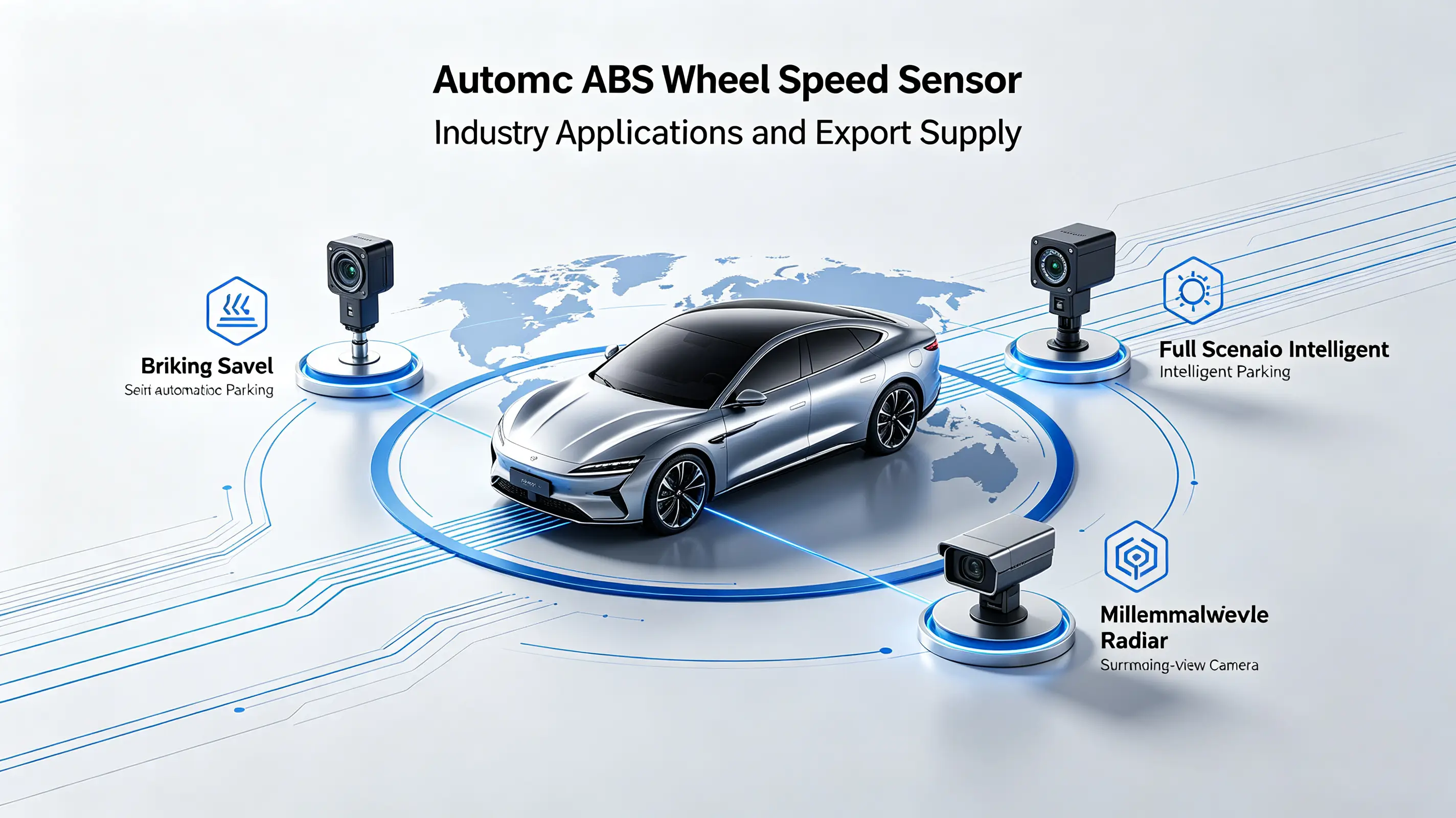
I. Overall Definition, Core Structure and Basic Working Principle of ABS Wheel Speed Sensors
As the underlying perception core for vehicle braking safety, electronic stability control and intelligent parking systems, ABS Wheel Speed Sensors continuously collect real-time rotational speed and steering direction data of four wheels, and transmit such data to ABS/ESP/Parking ECU to realize anti-lock braking, traction control, hill hold assist, automatic parking and other functions.
Two mainstream types are adopted across the industry: passive magnetoelectric sensors and active Hall-effect sensors. At present, active Hall-effect solutions have been fully deployed on global passenger vehicles, new energy vehicles and high-end fuel vehicles, and serve as the only compatible sensing carrier for automatic parking systems.
1. Complete Hardware Structure
An active Hall-effect ABS sensor consists of two main assemblies:
Signal Ring (Signal Rotor): Rotates synchronously with the wheel hub, with evenly distributed teeth and valleys that periodically alter magnetic field distribution.
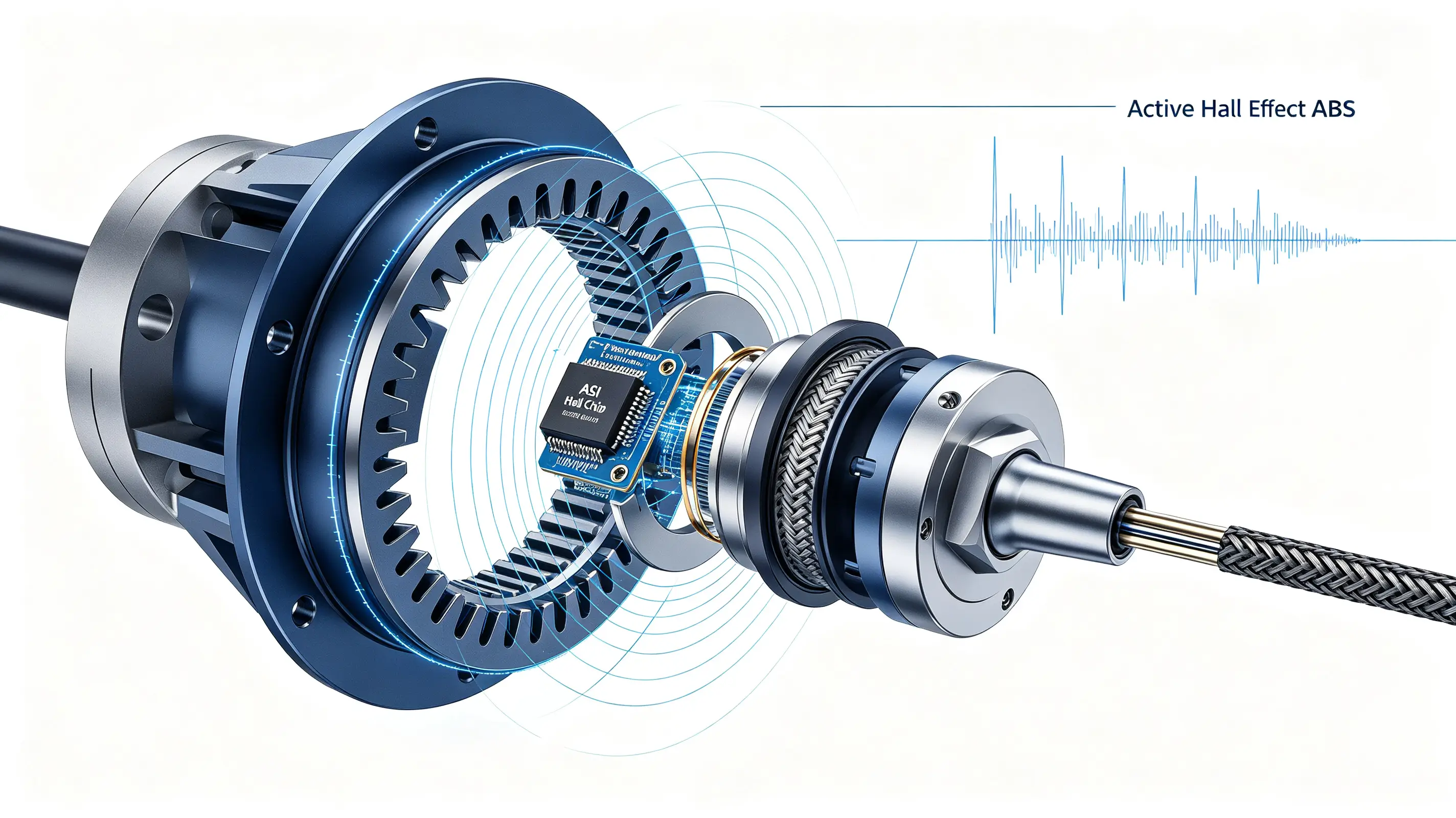
Sensor Probe Assembly: Integrates permanent magnets, dual-channel Hall sensing chips, dedicated ASIC signal processing ICs, shielded wiring harnesses and sealed metal housing components.
Different from passive magnetoelectric sensors, active Hall-effect sensors feature built-in power supply circuits powered by constant on-board voltage, with independent signal computation and self-check output capabilities.
Structural Comparison between Magnetoelectric and Hall-Effect Sensors Attached
2. Core Working Principle Based on Hall Effect
A constant operating current is applied to the semiconductor Hall chip, with a stable magnetic field superimposed in the perpendicular direction. When the wheel drives the signal ring to rotate, magnetic flux rises as a tooth approaches the probe and drops sharply as a valley passes by, generating periodic fluctuations in magnetic field difference and corresponding Hall potential difference at both ends of the chip.
The built-in ASIC chip completes signal amplification, filtering, temperature compensation and analog-to-digital conversion, and finally outputs stable digital pulse current signals with the following characteristics:
Pulse frequency corresponds to the real-time rotational speed of the wheel;
Phase difference signals distinguish forward and reverse rotation directions;
Supports accurate zero-speed detection at 0 km/h, completely eliminating the low-speed signal loss defect of traditional magnetoelectric sensors.
Schematic Diagram of Magnetic Field Variation and Output Pulse Waveform Attached
II. Three Generations of Active Hall-Effect Sensors by Positioning: Standard Basic Model, 1st-Gen BWM Parking & 2nd-Gen AK Protocol Parking
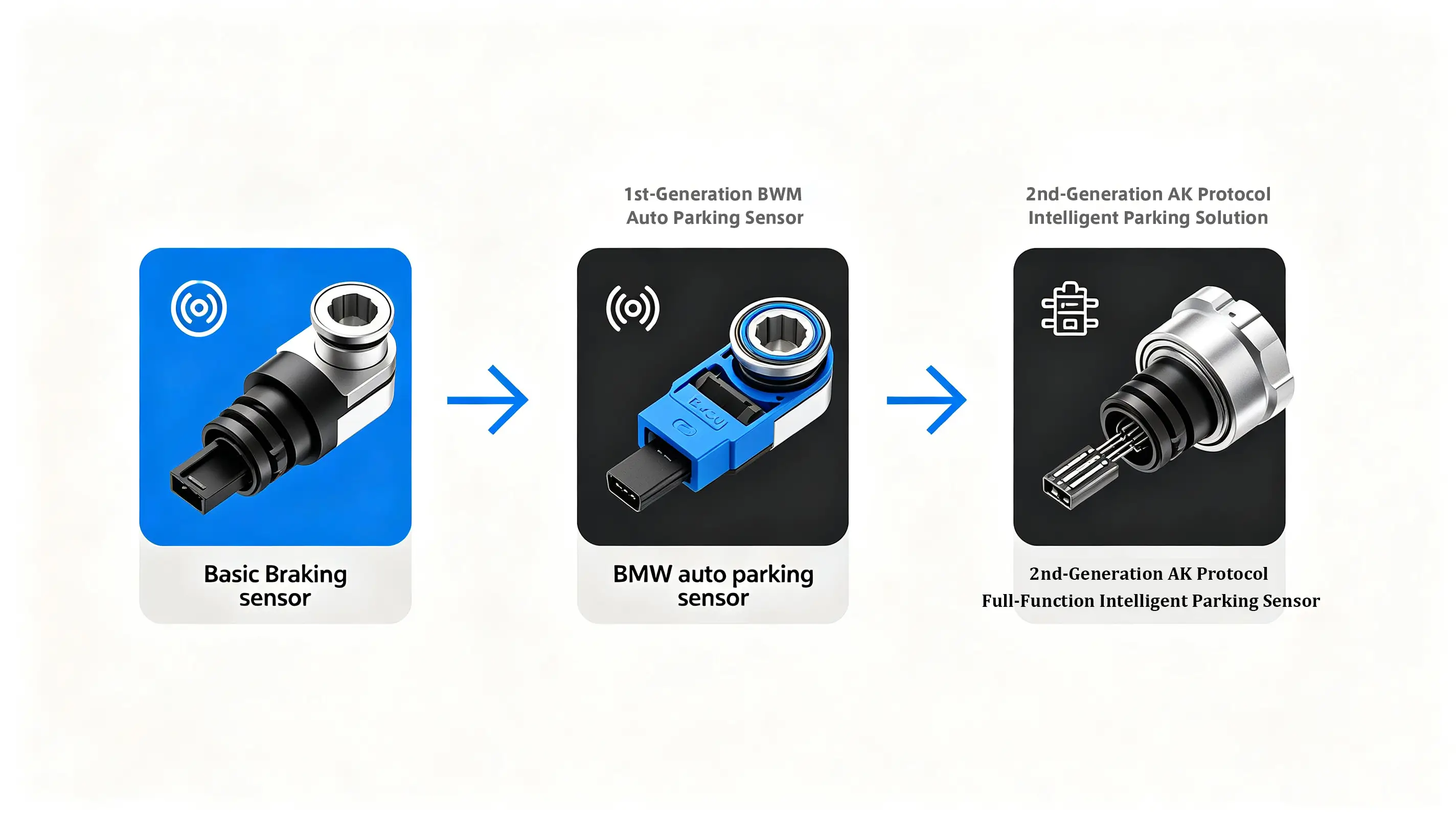
All three generations share the underlying Hall hardware architecture, magnetic circuit design, sealing structure and standardized mounting dimensions. They represent functional iterative upgrades built on the same technical foundation instead of fully independent technical routes. The evolution logic follows a progressive path: basic braking perception → entry-level automatic parking assist → full-function high-level intelligent parking, matching supporting demands of European German brands, American brands and domestic intelligent vehicle platforms.
(1) Standard Basic Active Hall-Effect ABS Sensor (General Chassis Base Model)
1. Technical Positioning
Solely serves basic braking safety systems including ABS, ESP, TCS and hill assist, without extended protocols for automatic parking. It was the mainstream standard active Hall-effect solution before 2010, compatible with entry-level household fuel vehicles, light commercial vans and older chassis platforms.
2. Signal Output & Hardware Features
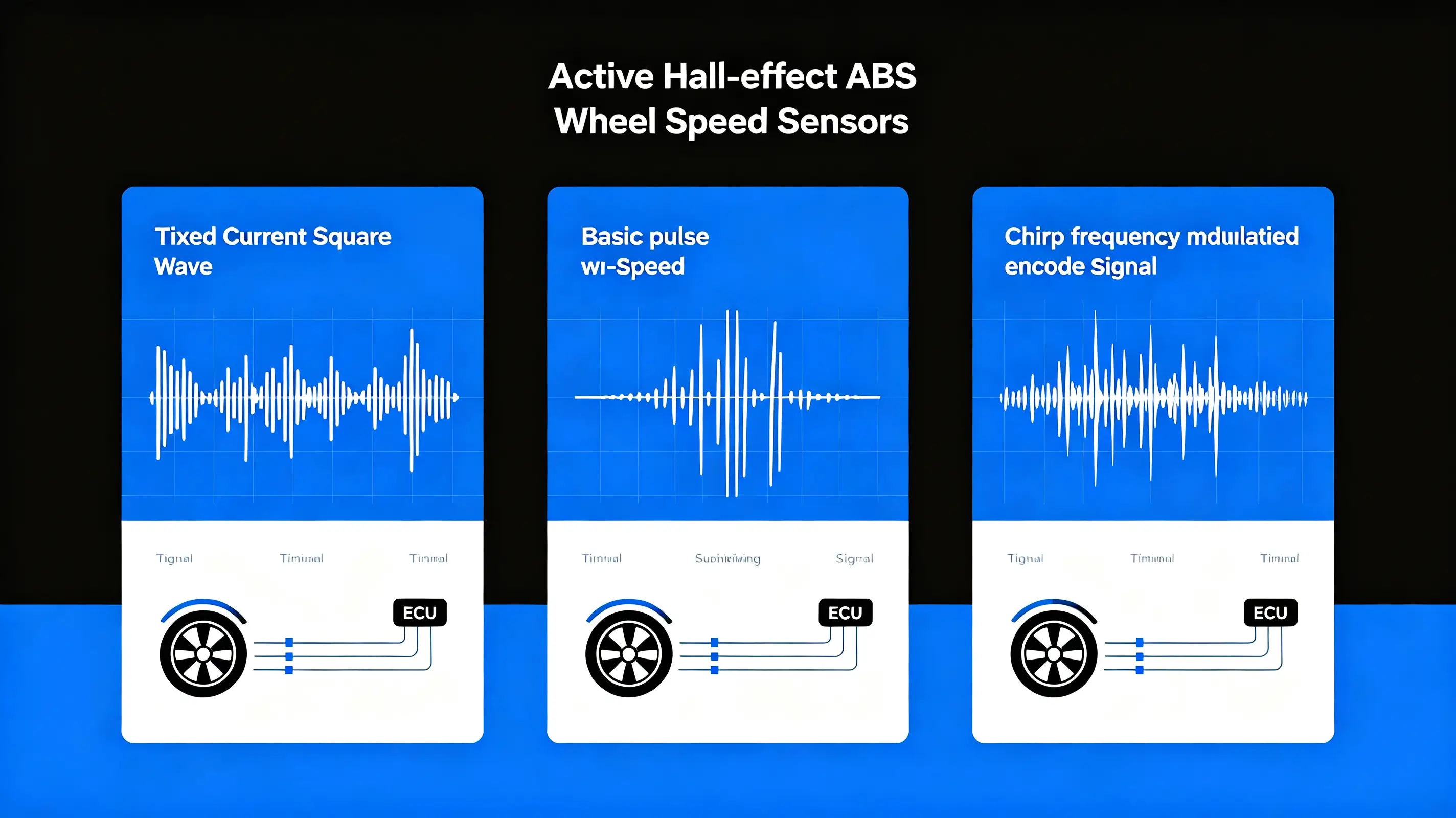
Two-wire current-mode square wave output, transmitting only two sets of basic data: rotational speed frequency and steering phase;
The ASIC chip only performs signal shaping without multi-dimensional data encoding or in-depth fault diagnosis modules;
Communicates exclusively with the braking ECU and cannot exchange data with parking radars or parking controllers;
Cost-effective with strong universality, accounting for the largest demand in overseas aftermarket replacement parts.
3. Performance Limitations
It merely meets the minimum standards for braking safety, unable to output signals for distance calibration, synchronous timing or multi-sensor collaborative identification, and does not support trajectory calculation for automatic parking. It acts as the technical prototype base for the 1st-Gen BWM parking sensor.
(2) 1st-Generation BWM Protocol Hall-Effect Sensor for Auto Parking (Matching 1st-Gen APA Parking)
1. Evolution Origin: Function Expansion Based on Basic Hall-Effect Model
While retaining the complete magnetic circuit, Hall sensing unit and housing sealing structure of general basic Hall sensors, the internal ASIC computing chip is upgraded with a new entry-level parking interaction protocol (referred to as the 1st-Gen BWM Parking Standard in the industry, the supporting specification for BMW’s original automatic parking in Europe). It enables data interconnection between braking systems and entry-level parking systems, marking the first iteration from basic sensors to dedicated intelligent parking sensors.
2. Core Upgrade Points
Expanded signals: Retains original rotational speed and steering signals, with additional high-precision subdivided low-speed pulses to support accurate trajectory calculation during low-speed parking maneuvers;
Bus compatibility: Supports early simple CAN/LIN communication, transmitting synchronous timing signals to both braking ECU and parking assist unit simultaneously;
Basic collaboration capability: Cooperates with original ultrasonic radars to recognize standard side and perpendicular parking spots and realize low-speed semi-automatic parking;
Hardware compatibility: Shares identical mounting holes, plug pinouts and air gap adaptation range with standard basic Hall sensors, minimizing chassis modification costs for OEMs.
3. Drawbacks of the 1st-Gen BWM Solution
Signals are transmitted via fixed-frequency polling, which easily causes co-frequency interference when multiple sensors operate simultaneously. It delivers low ranging resolution and long refresh cycles, only supporting short-distance low-speed parking, and cannot realize automatic parking-in, parking-out or intelligent adjustment for narrow parking spaces, thus driving the development of the standardized 2nd-Gen AK Protocol solution.
(3) 2nd-Generation AK Protocol Hall-Effect Sensor for Auto Parking (New Standard for Full-Function Intelligent Parking)
1. Iteration Relevance: Comprehensive Standardized Upgrade of 1st-Gen BWM Parking Technology
Co-developed by BMW, Mercedes-Benz and Volkswagen, the AK Protocol serves as a unified optimized standard built on the original 1st-Gen BWM parking technology. It fully inherits the magnetic circuit structure, core Hall sensing unit and mechanical mounting dimensions of the previous two generations, while reconstructing internal ASIC signal encoding, communication logic and functional safety architecture. It has become the standard configuration for global high-end fuel vehicles and new energy vehicles at present.
Full technical inheritance chain: Standard Basic Hall Sensor (Braking Only) → 1st-Gen BWM Hall Sensor (Entry-Level Semi-Automatic Parking) → 2nd-Gen AK Hall Sensor (Full-Scenario Fully Automatic Intelligent Parking)
2. Core Improvements Compared with 1st-Gen BWM Parking Sensors
Innovative signal encoding: Adopts Chirp frequency-modulated encoding, with an independent unique ID assigned to each wheel speed sensor. Multiple wheel speed sensors and bumper radars can transmit and receive data synchronously instead of alternating polling, compressing the system refresh cycle to less than 40 ms and drastically improving real-time parking response;
Enhanced measurement accuracy: Rotational speed subdivision precision increased by 10 times with a ranging resolution of ±1 cm, enabling precise identification of ultra-narrow parking spaces and low obstacles;
Qualified functional safety: The chip integrates a complete fault self-diagnosis circuit, complying with ISO 26262 ASIL-B automotive functional safety grade. Fault codes are refined to distinguish wire breakage, air gap offset, temperature drift and signal interference;
Full-scenario parking compatibility: Supports automatic parking-in, automatic parking-out, memory parking, valet parking and remote summon parking, and is compatible with multi-sensor fusion of millimeter-wave radars and surround-view cameras;
Expanded communication capacity: Supports the DSI3 high-speed communication protocol with a 5-fold increase in data transmission bandwidth, capable of uploading multi-dimensional data including rotational speed, steering angle, temperature and hardware health status to the vehicle domain controller simultaneously.
3. Backward Compatibility
The hardware mounting interface of 2nd-Gen AK Protocol Hall sensors is fully interchangeable with 1st-Gen BWM and standard basic Hall sensors. OEMs and overseas repair markets can smoothly switch product platforms, and older chassis can be adapted to 2nd-Gen products via ECU program upgrades. The high part commonality rate significantly reduces costs for export supporting and aftermarket inventory stocking.
III. Full Iteration Comparison Table of Three Generations of Active Hall-Effect ABS Sensors
表格
Comparison Dimension | Standard Basic Hall-Effect ABS Sensor | 1st-Gen BWM Auto Parking Hall-Effect Sensor | 2nd-Gen AK Protocol Auto Parking Hall-Effect Sensor |
|---|---|---|---|
Technical Foundation | Original active Hall design for braking perception only | Retains basic Hall magnetic circuit with newly added entry-level parking protocol | Standardized reconstruction of 1st-Gen BWM technology, with shared core hardware |
Core Application | Basic braking safety: ABS/ESP | Entry-level semi-automatic side & perpendicular parking | Full-scenario fully automatic intelligent parking & multi-sensor fusion |
Signal Mode | Fixed current square wave, only rotational speed + steering data | Basic pulses + low-speed subdivided timing signals | Frequency-modulated encoding with independent ID for synchronous signal transmission |
Communication Standard | Point-to-point connection exclusively with braking ECU | Simple CAN/LIN polling communication | Unified AK standard + DSI3 high-speed synchronous communication |
System Refresh Speed | ≥120 ms | 80–100 ms | <40 ms |
Measurement Resolution | Suitable for regular driving speeds | Basic precision for low-speed parking | ±1 cm high precision, covering all vehicle speeds |
Functional Safety | No dedicated diagnosis module | Simplified fault alarm function | Complete ASIL-B compliant functional safety self-check system |
Compatible Vehicle Models | Entry-level passenger cars, old chassis platforms, commercial vehicles | German vehicles equipped with original parking systems produced from 2015 to 2020 | High-end fuel vehicles and all new energy vehicles launched since 2020 |
Product Inheritance Relationship | Original technical prototype base | First upgraded version with expanded functions based on basic model | Mature mass-produced solution iteratively optimized from 1st-Gen BWM technology |
IV. Industry Development Trends & Export Supporting Value
Irreversible technological substitution: Passive magnetoelectric sensors are gradually phased out, with active Hall-effect sensors becoming the global standard. As penetration of intelligent parking continues to rise, 2nd-Gen AK Protocol Hall sensors will be the mainstream incremental product for overseas OEM pre-installation and aftermarket markets in the next five years.
Coexistence of three product generations in the market: Standard basic Hall sensors maintain stable demand for entry-level vehicles and vintage vehicle repair markets; 1st-Gen BWM parking sensors serve replacement demand for mid-range stock vehicles; new energy vehicles and high-end fuel vehicles adopt 2nd-Gen AK Protocol products as standard. The three product lines jointly support supply for cross-border independent stores overseas.
High part commonality advantage: The three generations feature highly unified mechanical structures and mounting dimensions, allowing manufacturers to share molds, production lines and testing equipment to cut production and export inventory costs, ideal for bulk supply via cross-border independent stores and one-stop matching for multiple vehicle models.
Competitive edge of domestic export products: Domestic active Hall chips and sealing processes have reached equivalent standards of European and American original manufacturers, covering both overseas OEM pre-installation and AM aftermarket channels, fully matching all chassis platforms of German, American and Chinese export vehicle brands.
Closing Section for Cross-Border Store Conversion
Our full lineup of active Hall-effect ABS wheel speed sensors covers three complete product ranges: standard basic model, 1st-Gen BWM auto parking model and 2nd-Gen AK protocol parking model. All products strictly follow original factory magnetic circuit design and international AK parking standards, and have passed full vehicle-grade tests including high & low temperature cycling, waterproof & dustproof sealing and electromagnetic interference resistance. We support mass OEM pre-installation matching and customized bulk orders for overseas aftermarket customers, compatible with chassis platforms of mainstream passenger vehicles and new energy vehicles worldwide.
If you require detailed technical datasheets, OEM vehicle compatibility lists or sample testing support, feel free to consult us online to obtain complete technical documents.