
Table of Contents
Introduction: The Precision Requirements of Automotive Sensor Assemblies
Magnetic Seals: Function and Wear Resistance
ABS End Covers: Protection and Sensor Integration
Wear Resistance in Automotive Environments
Materials and Manufacturing Processes
FAQ
1. Introduction: The Precision Requirements of Automotive Sensor Assemblies
Modern automotive sensor assemblies operate under demanding conditions—temperature fluctuations, moisture exposure, vibration, and road contaminants are constant challenges. The components used to seal, protect, and mount these sensors must maintain their integrity over hundreds of thousands of kilometers. Two critical components in these assemblies are magnetic seals and ABS end covers.
Wear resistance is a primary requirement for these components, as they protect the sensor from mechanical abrasion from moving parts, environmental debris and road contaminants, and repeated thermal expansion and contraction cycles that can cause surface wear. In automotive sensor assemblies, wear can lead to reduced sealing performance, signal interference from magnetic degradation, and premature component failure.
2. Magnetic Seals: Function and Wear Resistance
2.1 What Are Magnetic Seals?
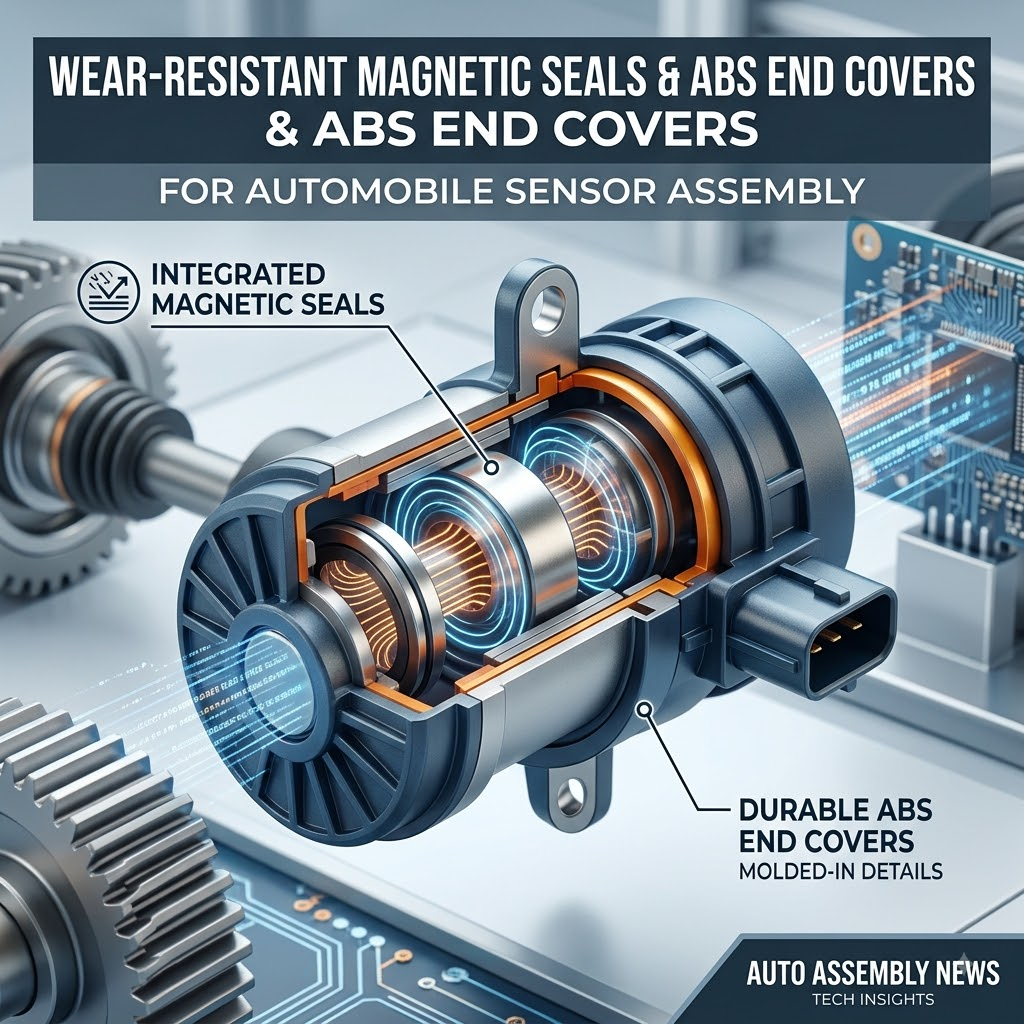
Magnetic seals in automotive sensors are used to protect sensing elements from external damage while maintaining the magnetic field integrity required for sensor operation. They serve dual purposes: physical sealing against environmental ingress, and magnetic shielding or field concentration. Seals can also act as magnetic flux concentrators, or as retainers for magnetic powder or paste in magnetic powder brake sensors.
Recent innovations in magnetic seal technology have focused on improving wear resistance through advanced material compositions. According to a 2025 patent from Magnetics Research Group, magnetic seals are being formulated with blends of ferrite and rare earth magnetic powders combined with powdered metals such as copper, aluminum, and tin, and bound with thermosetting resins.
2.2 Wear Resistance in Magnetic Seals
The wear resistance of magnetic seals is a function of material hardness, surface finish, and the presence of reinforcing materials. Research indicates that structural modifications at the molecular level can significantly improve wear resistance without altering magnetic performance. By incorporating protective nanoparticles into the thermosetting resin or by adding coating layers made of metals or organometallic compounds, manufacturers can create seals that maintain their dimensional and magnetic stability.
Wear resistance testing for magnetic seals typically includes:
Abrasion testing to simulate contact with rotating components
Environmental cycling to simulate temperature and humidity exposure
Mechanical fatigue testing to simulate long-term vibration exposure
3. ABS End Covers: Protection and Sensor Integration
3.1 The Function of ABS End Covers
ABS (Acrylonitrile Butadiene Styrene) end covers are used in automotive sensor assemblies as protective housings for the sensor and its associated electronics. In addition to physical protection, they provide accurate alignment for the sensor element, mounting points for integration into brake assemblies or wheel hubs, and maintain proper air gap for magnetic sensors.
The end cover design must ensure consistent positioning of the sensor element. A sensor that shifts by even a fraction of a millimeter can affect the air gap, leading to signal variation and inconsistent sensor performance. Additionally, the end cover must prevent moisture and dust ingress that could compromise electronic connections.
3.2 ABS Material Properties and Wear Resistance
Advanced ABS compounds have been developed to improve wear resistance while maintaining the material's inherent strength and dimensional stability. Specific wear-resistant formulations incorporate fillers such as glass fiber, PTFE, and molybdenum disulfide to reduce friction and wear.
Material Modification | Impact on Wear Resistance |
Glass fiber reinforcement | Increases surface hardness, reduces wear |
PTFE addition | Reduces coefficient of friction, improves wear performance |
Carbon fiber | Improves abrasion resistance and dimensional stability |
Surface treatments | Hard coatings applied to critical surfaces |
In many automotive applications, ABS end covers are bonded with other components—such as a stainless steel cylindrical cover and a temperature sensor—using adhesives, laser welding, or ultrasonic welding, depending on the required seal integrity and temperature resistance.
4. Wear Resistance in Automotive Environments
Wear resistance requirements differ significantly depending on the sensor's location in the vehicle. Wheel speed sensors are exposed to road debris, brake dust, and continuous vibration, requiring the highest wear resistance. Engine and transmission sensors operate at elevated temperatures and face exposure to oils and chemicals. Pedal and steering sensors experience lower wear but require consistent performance over long service intervals.
Key factors affecting wear in automotive sensor assemblies:
Thermal cycling: Repeated expansion and contraction can cause material degradation
Chemical exposure: Brake fluid, oil, and road salt can accelerate wear
Mechanical abrasion: Contact with rotating components or road debris
UV and ozone: Deterioration of polymers in exposed locations
5. Materials and Manufacturing Processes
5.1 Magnetic Seals
Material options for magnetic seals:
Material Type | Wear Resistance | Magnetic Properties | Typical Application |
Nickel-plated ferrite | Good | Moderate flux density | General sensors |
Rare-earth bonded magnets | Fair to good | High flux density | High-sensitivity sensors |
Ceramic magnets | Poor to fair | Moderate flux density | Cost-sensitive applications |
Samarium cobalt | Excellent | High flux density | High-temperature applications |
Advanced seal designs incorporate wear-resistant coatings such as nickel, chrome, or diamond-like carbon (DLC), offering improved protection for demanding applications such as wheel speed sensors, ABS sensors, transmission speed sensors, and camshaft position sensors.
5.2 ABS End Covers
Manufacturing processes for ABS end covers:
Injection molding: The standard process for ABS end covers, allowing for complex geometries and tight tolerances. The mold design must account for the dimensional stability of the ABS material.
Overmolding: Used when the cover must be bonded with another material, such as a rubber seal. The ABS is molded directly onto the seal or insert.
CNC machining: For prototypes and low-volume production, CNC machining can be used to fabricate covers from ABS stock.
6. FAQ
Q: What is the primary function of a magnetic seal in a sensor assembly?
A: A magnetic seal in a sensor assembly has two primary functions: physically sealing the sensor against environmental ingress, and providing magnetic flux concentration or shielding to maintain the magnetic circuit integrity required for sensor operation. In magnetic powder brake sensors, it also acts as a retainer for the magnetic powder.
Q: Why are ABS end covers preferred over metal covers for some sensor assemblies?
A: ABS offers several advantages for sensor assembly applications: it is lightweight, cost-effective for injection molding, provides excellent dimensional stability, and can be formulated with fillers to improve wear resistance. Additionally, ABS does not interfere with magnetic fields, making it suitable for use with magnetic sensors.
Q: What is the typical life expectancy of a sensor assembly magnetic seal?
A: Sensor assembly components are designed to match the service life of the vehicle, typically 150,000 km or more. Under normal operating conditions, wear-resistant magnetic seals with advanced coatings can last the entire service life without degradation in performance.
Q: How does moisture ingress affect sensor assemblies?
A: Moisture ingress can cause corrosion of electrical connections, short circuits, and signal interference. In magnetic sensors, moisture can also cause magnetic material degradation, leading to reduced sensor sensitivity or failure. This is why seals and end covers must provide effective moisture barriers.
Q: Can ABS end covers be bonded to metal components?
A: Yes. ABS end covers can be bonded to metal components such as stainless steel cylindrical covers using adhesives, laser welding, or ultrasonic welding. The bonding method depends on the required seal integrity and temperature resistance. ABS-to-metal bonding is common in sensor housings that combine the structural strength of metal with the lightweight and non-magnetic properties of ABS.